Inaugural Langtangen prize: Simula–Brown collaboration produces a new algorithm for computer simulations
Published:
When computers simulate the real world, from engines firing in automobiles to airplanes flying in the sky, they involve sophisticated mathematical models known as Partial Differential Equations (PDEs). The challenge intensifies when these models incorporate pointwise inequality constraints, such as ensuring that the steel frame of a simulated car correctly deforms around a wall during a crash rather than passing through it. These constrained PDE problems are mathematically known as Variational Inequalities (VIs).
Variational inequalities pose significant challenges across engineering disciplines, often demanding specialised numerical techniques tailored to each new application.
The recent paper by Thomas Surowiec (Simula) and Brendan Keith (Brown), titled “Proximal Galerkin: A Structure-Preserving Finite Element Method for Pointwise Bound Constraints,” addresses this challenge and has been awarded the inaugural Langtangen Prize for introducing a radically new and systematic framework for solving VIs.
Read the full, open-access article here: Proximal Galerkin: A Structure-Preserving Finite Element Method for Pointwise Bound Constraints
The breakthrough: a unifying framework
When deriving the new method, Proximal Galerkin (PG), the authors confront how standard numerical solvers, like the Finite Element Method (FEM), handle these tricky pointwise constraints.
In response, the authors suggest a new approach: combining a traditional computational technique, the Galerkin method, with a generalisation of a classical algorithm from optimization: the proximal point algorithm. The next key innovation is to introduce an additional “latent” variable into the mix, transforming the original (hard-to-solve) VI into a series of easier, unconstrained PDEs.
The result is an algorithm that is efficient and easy to implement. It is also structure-preserving, meaning the physics, the fundamental rules and constraints governing the system, are respected throughout the entire simulation, preventing non-physical results and ensuring high accuracy.
This breakthrough has several significant practical advantages:
- Reliability: The method guarantees that physical constraints are always satisfied, leading to results that are robust and trustworthy, even for complex, non-smooth problems.
- Efficiency: The PG method allows for the use of high-order Finite Element bases (which increase accuracy without drastically increasing computation time) and produces sparse systems that can be solved very quickly using established techniques.
- Mesh Independence: The required iterations for solving the system do not grow unboundedly as the mesh is refined, making large-scale, high-resolution simulations practical.
This prize-winning work provides a critical new tool for engineers and scientists looking to perform high-fidelity simulations in fields where VIs are ubiquitous.
The next step: from foundation to frontier
The Proximal Galerkin (PG) method is not just a theoretical achievement. It serves as the starting point for a new FRIPRO research project at Simula aimed at developing further advancements in constrained simulation technology.
Learn more about the research project: "LaVa: The Latent Variable Proximal Point Method: A structure‐preserving approach to constrained variational problems"
About the award
The paper was awarded the inaugural Langtangen Prize, named for Prof. Hans-Petter Langtangen (1962–2016). Langtangen was one of the founding members of Scientific Computing at Simula and the director of the Center of Excellence for biomedical computing 2007-2016. His work had a tremendous impact on the field of scientific computing and open source software. For Simula, it is particularly gratifying that the first prize is awarded to one of our researchers.
This prize is awarded annually to an outstanding paper or papers on the foundations of numerical simulation technology published in the previous calendar year. It is funded by the Ridgway Scott Foundation, and the authors of each paper receive a cash award of 3,000 USD.
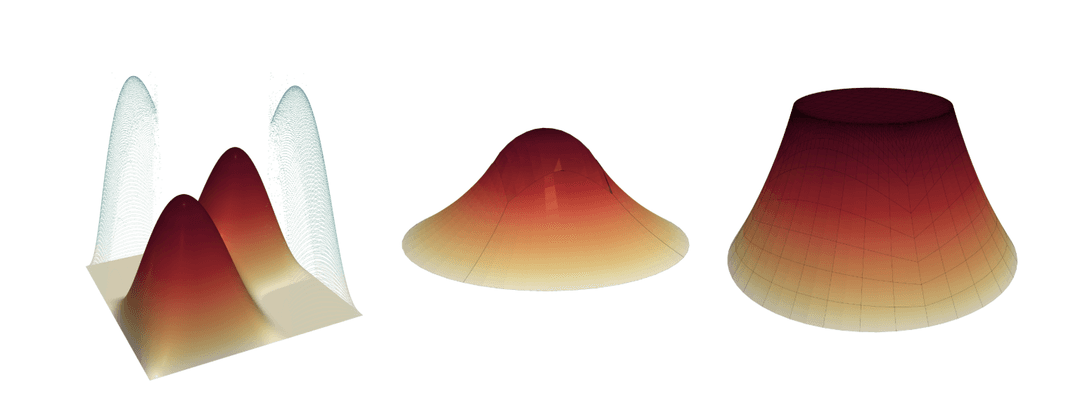
Figure: Three solutions to the classic obstacle problem computed using the Proximal Galerkin (pG) method. (left) The solution (red-to-gold) and the corresponding Lagrange multiplier (green, transparent), which indicates where the constraint is active; (middle) A bound-preserving solution computed using 13th-degree polynomials on a coarse, five-element grid; (right) A non-smooth solution demonstrating the method's effectiveness with adaptive mesh refinement.
This popular science article was generated in part by Gemini, a large language model trained by Google. It has further been revised by a communications advisor and the paper authors.