New funding for math to link how we think with how the brain moves
Published:
Simula is thrilled to share that the project BrainComplexes (From connectomes to continua: new complexes in brain multiphysics), has been funded by the Research Council of Norway through the FRIPRO portfolio for ground-breaking research.
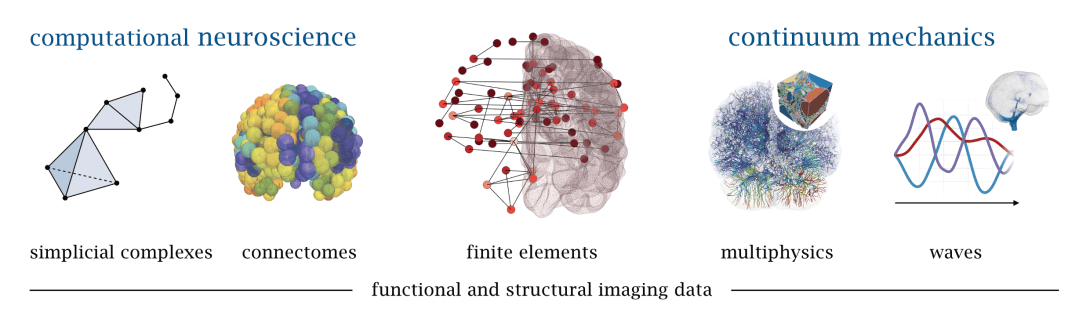
The primary objective of BrainComplexes is to establish a scale-bridging framework for brain multiphysics by developing the computational foundations and numerical technology required to solve coupled partial differential equations (PDEs) on multilayer simplicial complexes. Hosted by the Numerical Analysis and Scientific Computing department at Simula Research Laboratory, this 4-year project is planned to launch in early 2027.
“The funding allows us to bring together a terrific multidisciplinary team from Scientific Computing at Simula, the Department of Neurosurgery at Oslo University Hospital (Norway), the Mathematical Institute at the University of Oxford (UK), the Institute for Medical Engineering and Science at MIT, and the School of Medicine at Tufts University” says Project leader and Chief Research Scientist Marie E. Rognes.
The challenge: connectomes vs. continua
The human brain is a beautifully complicated multiphysics system. When studying brain electrophysiology – the "wiring and firing" of the brain – neuroscientists classically model it using discrete graphs, or connectomes. But to describe the physical brain – its waves of fluid flow, the poromechanics of the tissue, and the transport of ions and solutes – our models typically use partial differential equations (PDEs) defined over a continuum. Today, there is a distinct gap between these two mathematical worlds. BrainComplexes aims to bridge it.
"This FRIPRO grant is a big win” Rognes continues. “Dedicated funding for this type of basic research with a long-term perspective is absolutely vital for our field. Having the structural support to study the very fundamentals of how we model the brain is a true privilege. It gives us the freedom and stability to explore fundamental questions that may take years to mature before they can yield scientific breakthroughs."
From mathematical foundations to translational medical research
This project represents the next step in a longer-term research programme within Scientific Computing at Simula that moves from mathematical foundations to translational medical research and clinical application, and now, returning to new abstractions:
"A decade ago, we started essentially from scratch with research into the mathematical and computational foundations for modelling brain fluid flow through the Waterscales and Waterscape projects funded by the European Research Council and the Research Council of Norway, respectively. Today, those exact modeling efforts have transitioned out of the mathematical realm and into translational medicine within the K. G. Jebsen Centre for Brain Fluid Research.
With BrainComplexes, we are turning our attention to a new mathematical challenge. This project is about creating the mathematical foundations needed to bridge the gap between network-based electrophysiology and continuum mechanics. In short, we want to establish new enabling technology to understand the intricate interplay between how we think and how the brain moves." Rognes concludes.
Stay tuned for upcoming open PhD and Postdoc positions as the team prepares for a 2027 launch.