A brief history of FEniCS: the evolution of automated Scientific Computing
Published:
What started as a bold, small-scale attempt to automate code generation has grown into a pillar of global scientific infrastructure, where Simula has nurtured and sustained it for over twenty years.
The automation of mathematical modeling has been a major step forward in modern Scientific Computing. For over two decades, the FEniCS Project has fundamentally changed how scientists and engineers translate complex physical phenomena into high-performance numerical simulations. Although FEniCS is a huge open-source project involving many organizations, its development is deeply tied to Simula Research Laboratory. From the mid-2000s onward, Simula served as a central developmental hub, providing the institutional stability, and the world-class talent necessary to transform an ambitious academic concept into a widely adopted platform..
Origins: From an academic idea to a collaborative project (2003–2005)
FEniCS was designed to ease a major burden for mathematicians: implementing the finite element method (FEM) efficiently.
Historically, solving the partial differential equations (PDEs) governing physical systems suffered from immense implementation barriers. Researchers were forced to manually write tens of thousands of lines of low-level code for every unique equation or local assembly kernel. This equation-by-equation manual implementation was slow, highly error-prone, and severely restricted widespread experimentation with advanced numerical methods.
The initial breakthrough came from a desire to completely automate this pipeline. Early core concepts were explored during Anders Logg’s PhD work at Chalmers University of Technology and subsequent postdoctoral research at the University of Chicago. The founders envisioned the following:
“The vision of FEniCS is to set a new standard in Computational Mathematical Modeling (CMM), which can be described as the Automation of CMM, towards the goals of generality, efficiency, and simplicity, concerning mathematical methodology, implementation, and application.”
- Todd Dupont, Johan Hoffman, Claes Johnson, Robert Kirby, Mats Larson, Anders Logg, Ridgway Scott, The FEniCS Project plan 2003 (https://a654cc05c43271a5d22f-f8befe5e0dcd44ae0dccf352c00b4664.ssl.cf5.rackcdn.com/documents/fenics/fenics-projectplan/fenics-projectplan.pdf)
At this stage, FEniCS was an experimental project driven by fewer than half a dozen developers worldwide. The turning point occurred in late 2005. As recalled by Marie Rognes, Simula’s late, pioneering professor Hans Petter Langtangen attended a FEniCS meeting in Chicago. Langtangen immediately recognised that this automated approach represented the future of computational science. Simula championed the project, actively orchestrating the recruitment of Anders Logg to bring the platform to Norway.
The Centre of Excellence (2006–2017)
When Anders Logg arrived at Simula in 2006, the development of DOLFIN, the primary user-facing engine of FEniCS, gained a central home. Open-source scientific software packages are notoriously fragile; without continuous institutional backing, many promising academic projects fragment when initial research grants expire. Simula broke this cycle in 2007, when the Research Council of Norway awarded the laboratory the Centre of Excellence for Biomedical Computing (CBC). Led by Langtangen, the CBC provided stable funding that allowed Simula to scale a dedicated development team.
During this highly collaborative window, the core team expanded to include researchers who researchers who advanced the state of both mathematics and computational engineering:
- Martin S. Alnæs developed the Unified Form Language (UFL), a domain-specific language that permitted mathematicians to write down weak variational forms that closely resemble the traditional pen-and-paper notation. In fact, UFL’s elegance extends far beyond FEniCS as it has been adopted by other FEM software, such as DUNE and Firedrake, and has served as a blueprint for domain specific languages for other FEM packages.
- Marie E. Rognes joined the core effort in 2007, pioneering the efficient automated assembly of non-trivial mixed finite elements.
- Kent-Andre Mardal worked alongside Langtangen to apply FEniCS to complex fluid dynamics and advanced preconditioning techniques.
- Johannes Ring was hired via the Centre as a dedicated research software engineer. His entire remit was providing continuous maintenance, robust installer packages, and systematic testing environments, giving FEniCS a level of reliability and continuity that few other academic software projects possessed.
- Simon Funke
A key milestone of this era was the 2012 publication of the seminal FEniCS Book, edited by Logg, Mardal, and Wells. Langtangen also integrated the software into curricula at the University of Oslo, ensuring that FEniCS built a permanent user base. This educational push culminated in 2016 with the release of “The FEniCS Tutorial: Solving PDEs in Python." (10.1007/978-3-319-52462-7).
Global impact: from neurocellular pathways to automatic differentiation
By the 2010s, FEniCS became a core infrastructure supporting scientific discovery and education worldwide. Its use is documented across high-impact journals, from glaciologists modeling ice cliff instabilities to volcanologists simulating magma storage systems.
Biomedical breakthroughs at Simula
Simula researchers used FEniCS to build highly advanced models in computational physiology. Notably, the software became the engine for groundbreaking 3D neuro-modeling, simulating how interstitial fluids move and how metabolic waste is cleared within the human brain. Simula scientists also deployed FEniCS to model blood flow patterns in cerebral aneurysms, helping medical researchers determine structural indicators for when an aneurysm might safely be left alone or when it is likely to burst.
The Wilkinson Prize and add-on ecosystem
The architectural elegance of FEniCS invited developers to build powerful tools directly on top of its core libraries. A multi-institutional team including Simula's Marie E. Rognes developed Dolfin-adjoint (see scientific article). This package automated the derivation of discrete adjoint models, enabling researchers to solve massive optimization and inverse problems with minimal code modifications. In 2015, this breakthrough was awarded the prestigious J.H. Wilkinson Prize for Numerical Software, exemplifying how the core principles of FEniCS continued to yield significant computational spin-offs.
Industrial adoption
Adapting open-source academic codes into multi-decade industrial workflows is known to be difficult, but FEniCS has bridged this issue.
An example is the ASIMOV project, where Rolls-Royce plc and University of Cambridge initiated the development of next-generation finite element stacks on top of FEniCS. The project aimed to perform high-fidelity, whole-engine multiphysics simulations on jet engines that coupled thermal, fluid, and electromagnetic behaviour simultaneously to accelerate net-zero propulsion technologies.
In other examples, small and medium enterprises like Undabit, Rafinex, Firon ApS and Proxima Fusion have developed some of their core infrastructure on top of the FEniCS framework due to its permissible licensing and transparency.
FEniCS today
In 2016, FEniCS became part of the NumFOCUS Sponsored Projects, which provides fiscal administration, along with operational and legal support to ensure its long-term sustainability. Since then, the project has been guided by a formal Steering Council, featuring five Simula employees to date:
- 2016-2018: Martin S. Alnæs
- 2016-2023: Johannes Ring
- 2016-2024: Marie E. Rognes
- 2022 - : Jørgen S. Dokken
- 2024 - : Cécile Daversin-Catty
As the landscape of high-performance computing (HPC) underwent a structural shift toward multi-GPU architectures, cloud environments, and exascale supercomputers, the original FEniCS code base met its physical design limits. In 2019, the development of the next-generation platform, named FEniCSx, was initiated. These efforts have resulted in an extensible, scalable ecosystem that can be used for simulations across hundreds of thousands of CPU cores, while maintaining the remarkably simple, highly readable code syntax that has defined the project since its inception.
In 2026, the FEniCS Project team members were awarded the EMS/ECMI Lanczos Prize for Mathematical Software for their revolutionary contributions to the implementation of the finite element method. Notably, four of the recipients are past or present affiliates of Simula.
For more about the software, documentation, and the global developer community, visit The FEniCS Project official website.
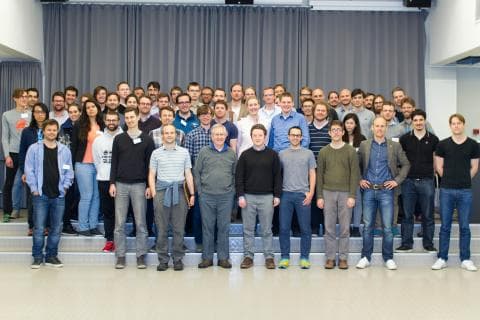
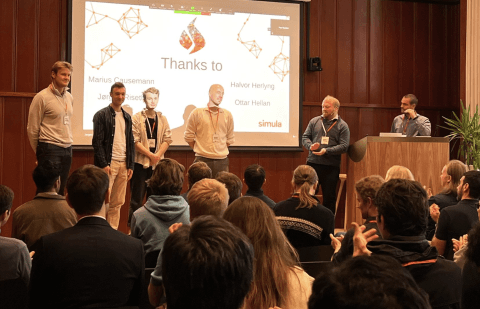
FEniCS conferences through the years