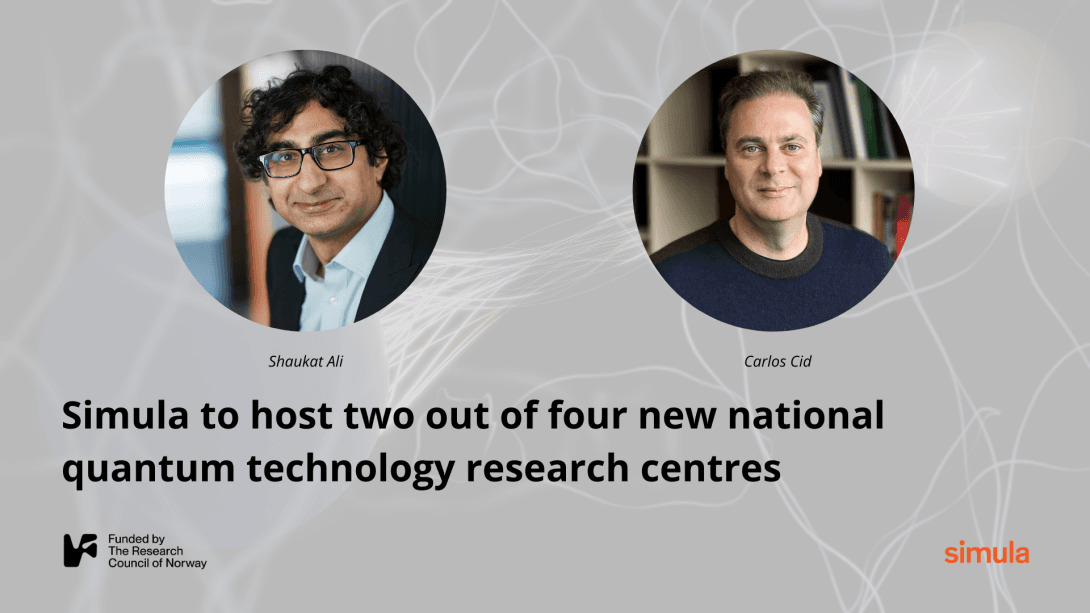
Simula to host two out of four new national quantum technology research centres
Published:
The Research Council of Norway has awarded Simula two quantum technology research centres and a partnership role in a third. The centres will advance quantum software research and quantum communication networks, critical areas for making quantum technologies accessible, reliable, secure and ready for real-world use.
In May, the Research Council of Norway announced that they will strengthen research in quantum technology and fund four new centres in this field, spanning the three pillars of quantum communication, quantum computing and quantum sensing. Today, Simula was awarded two of these centres with a combined budget of approximately NOK 120 million over five years.
This was announced in a press release from the government on December 17, 2025 (regjeringen.no).
"To be awarded two out of four quantum technology centres is a milestone for Simula and a recognition of the strong expertise that has been built over many years," says Managing Director Lillian Røstad.
The two new centres are the Norwegian Quantum Software Center (NorQSoft) led by Shaukat Ali from Simula Research Laboratory and the Centre for Quantum Communication Networks and Applications (QCNA) led by Professor Carlos Cid from Simula UiB. Simula will also participate as a partner in the Centre for Quantum Computing and Applications (QSTAR) hosted by SINTEF.
“We are very pleased to see these critical areas being prioritized. While global investment has often addressed the "hardware race" to build physical devices for quantum computing and quantum communication, these new centres target the software and infrastructure layers needed to make quantum information technology accessible and trusted,” says Professor Are Magnus Bruaset, Director of Software and AI at Simula.
NorQSoft: Building reliable quantum software
The Norwegian Quantum Software Center (NorQSoft) will conduct foundational research on quantum application software, the quantum software stack, and quantum artificial intelligence.
Recent advances indicate that we are moving towards real-world applications of quantum technologies. But developing reliable and cost-effective applications based on quantum software is still a challenge.
“With this centre, we will create quantum software technologies that are useful and relevant for the real world. We’ll develop the necessary foundations and implement them in prototype tools, and validate their feasibility and cost-effectiveness through academic and industrial case studies,” says centre leader, Shaukat Ali.
NorQSoft will also establish a world-class education programme for quantum computing. This programme will lower the entry barriers and train the next generation of professionals.
NorQSoft Partners: Simula (Host), OsloMet, SINTEF, Chalmers University of Technology (Sweden), University of Southern Denmark, National Institute of Informatics (Japan), and industry partners including DNV, Syngens, ORCA Computing, and Quantinuum.
QCNA: Securing the Quantum Internet
The Centre for Quantum Communication Networks and Applications (QCNA) will be a key driver of the development of quantum communications in Norway. A primary deliverable for QCNA is the establishment of Norway’s first experimental test network for quantum communication, which will be integrated with Telenor’s 5G platform and use equipment from Toshiba.
With a view to future applications, the Centre will also develop next-generation quantum cryptographic algorithms and protocols, investigate error-correction techniques for advanced distributed quantum applications, and study how quantum communication technologies can be integrated into future digital infrastructures.
"This Centre is designed to ensure that Norway develops the knowledge, expertise and capacity needed to design secure and reliable quantum communication protocols and applications, while also contributing to international efforts in quantum communications", says the Centre leader, Professor Carlos Cid.
QCNA will also design and evaluate architectures and protocols for the emerging “quantum internet” and contribute to international standardisation processes in quantum technologies.
Like NorQSoft, education is central to QCNA's mission. The Centre will train PhD students and postdoctoral researchers, contribute to university courses, and deliver specialised upskilling programs for telecommunications professionals.
QCNA Partners: Simula UiB (Host), SimulaMet, SINTEF Digital, NTNU, Aalborg University (Denmark), Okinawa Institute of Science and Technology (Japan), Telenor and Toshiba Europe.
Partnering in QSTAR
The Centre for Quantum Computing and Applications (QSTAR), hosted by SINTEF and led by Franz Fuchs, will focus on developing error correction methods, algorithms, and software required to make quantum computers reliable and useful. The research targets demanding challenges in science and industry, particularly within quantum chemistry and optimization, serving as test areas of high scientific and industrial relevance.