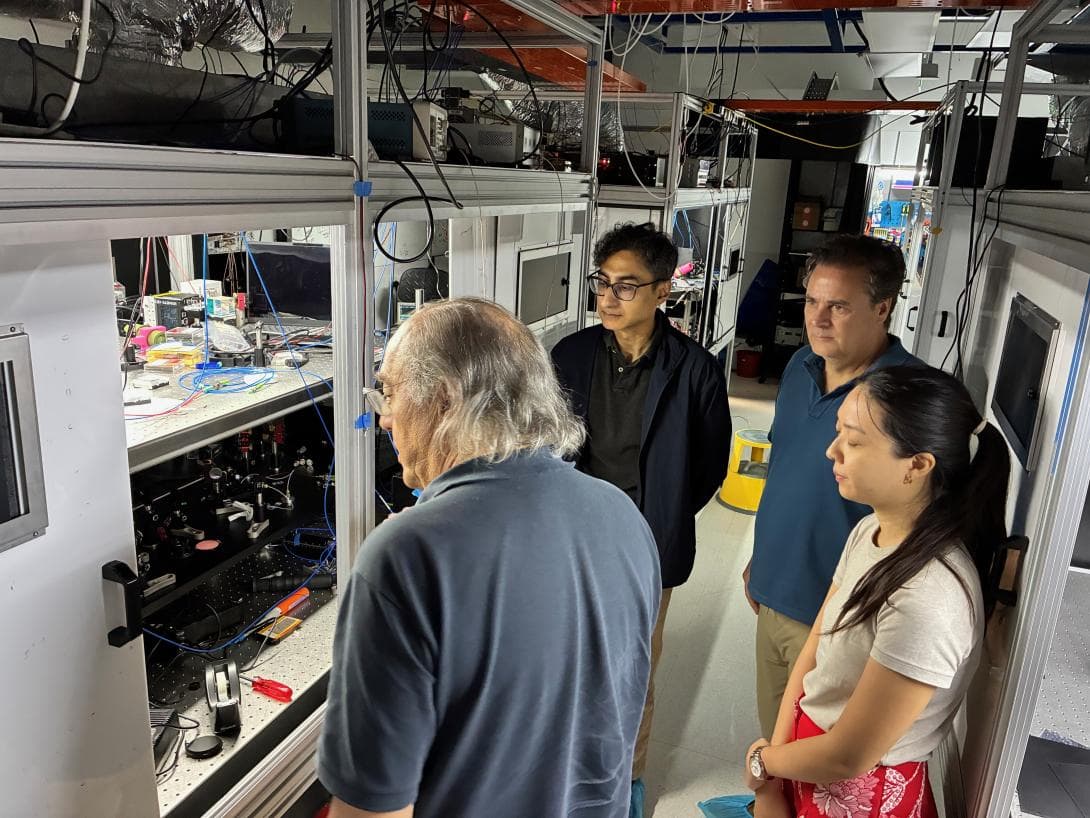
Simula's quantum research centres visit Singapore
Published:
Simula researchers spent a week in Singapore to learn from one of the world's leading quantum research ecosystems.
On Monday, 24. August, Are Magnus Bruaset, Shaukat Ali and Carlos Cid travelled to Singapore. By the end of the week, they'd sat down with national research centres, a spin-off building satellite-based quantum communications, an investment agency, a university, and a quantum computing company installing one of the most advanced machines in the world.
The trip grew out of the work of Simula's two national quantum research centres: NorQSoft – Norwegian Quantum Software Center, led by Ali, and the Centre for Quantum Communication Networks and Applications (QCNA), led by Cid and hosted at Simula UiB.
“NorQSoft and QCNA share the goal of delivering excellent research and also actively contributing to quantum innovation in Norway through a growing portfolio of adjoint projects. The recipe is well known to Simula – to deliver this type of excellence, one needs to collaborate with the best. In particular, for quantum, this means one has to look globally,” said Bruaset, who leads the quantum research initiative at Simula.
Why Singapore?
Singapore is similar in population and GDP to Norway, a long-time trading partner (especially at sea), and a country whose government has put serious weight behind research and innovation. That backing has helped it build a quantum scene that's unusually well organised, Bruaset noted.
The visit was planned with help from Bjørn Simonsen, Innovation Norway's tech counsellor in Singapore, and started with a stop at the Norwegian Embassy before the researchers moved on to a packed schedule with the local quantum community.
Complementary strengths
First up was the Centre for Quantum Technologies (CQT), Singapore's flagship national research centre for anything quantum. Founded in 2007, it now employs close to 350 people. Bruaset said what struck him from that very first meeting was how openly CQT talked about its own research and pain points.
It became clear that Simula's strengths in quantum software engineering and post-quantum cryptography lined up well with what Singapore is building.
Returning with concrete ideas
Over the next couple of days, the group met two national programmes: the National Quantum Computing Hub (NQCH) and the National Quantum-Safe Network (NQSN) Testbed.
“One of the main deliverables of QCNA will be Norway’s first quantum communication testbed. Learning from testbeds already deployed elsewhere is essential to our work, and it’s impressive what the project has achieved,” said Carlos Cid, director of QCNA.
Both conversations turned up concrete ideas: working with NQCH on the open-source quantum computing platform Qibo, and pairing Norwegian and Singaporean know-how in quantum key distribution and post-quantum cryptography.
Representatives from the National Quantum Office, which runs Singapore's national quantum strategy, joined the NQCH meeting too.
Next came SpeQtral, a company spun out of CQT that builds satellite-based quantum-secure communications systems, followed by a meeting with its early investor SGInnovate, Singapore's equivalent of Innovation Norway, and a serious investor in the local quantum sector.
Quantum software collaborations and the Helios system
The week wrapped up with two more stops. First, the Singapore University of Technology and Design (SUTD). Shaukat Ali, director of NorQSoft at Simula, noted how their ambition for quantum computing and quantum-inspired computation are potential points of collaboration with the NorQSoft centre.
Then Quantinuum, a quantum computing company the group already knew well from the UK. Quantinuum's Singapore office is currently installing a Helios system, one of the most accurate quantum computers built so far, and the first of its kind outside the US.

Simula hosts two national quantum technology research centres:
- NorQSoft – Norwegian Quantum Software Center (Simula Research Laboratory)
- QCNA – Centre for Quantum Communication Networks and Applications (Simula UiB)
Both centres are newly established; follow their work on LinkedIn. Websites are in development.