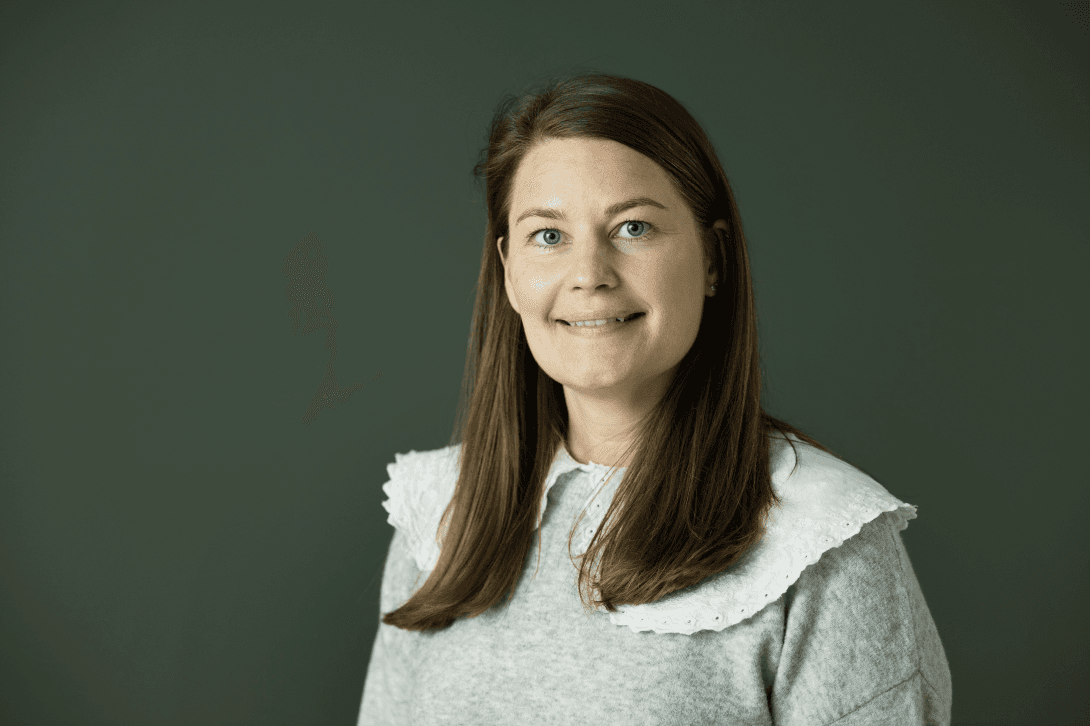
Spotlight: Ada Johanne Ellingsrud
Published:
Recently, Ada Johanne Ellingsrud, Research Scientist and Head of Department for the Numerical Analysis and Scientific Computing Department at Simula was interviewed.
Her research specialisations are in scientific computing, numerical modelling, and computational neuroscience.
Can you describe your area of expertise?
I work on mathematical and numerical modelling of the interplay between brain cells and their surrounding environment. My expertise is in developing and using computational models to study how electrical and chemical signals control functions like neuronal firing, ionic homeostasis, and volume control. The models I consider are physics-based (as opposed to data-driven) and are formulated through partial differential equations (PDEs), a type of equation that relates how quantities of interest change in space and time. My research profile is interdisciplinary, and I combine methods and knowledge from scientific computing, numerical modelling and neuroscience.
What are your current projects?
The work that is my primary focus now is part of the EMIx project at Simula. In this project, we have extended the classical cell-by-cell model by incorporating how electrical and chemical processes interact, enabling us to capture the underlying dynamics in, for example, brain diseases such as epilepsy. The equations are complex and challenging to solve. For now, we have mainly focused on developing solution algorithms for these new models. We are approaching the stage where we can start applying geometries from medical imaging and conduct more realistic computational studies, which I am very excited about.
I also work with modelling the interactions between neurons and glial cells, which is a type of brain cell that is essential for the well-being of the brain. Specifically, I study how glial cells help maintain ionic homeostasis and their role in microscopic fluid flow and volume control in the brain.
Are there emerging trends or technologies within your field that you find particularly exciting or promising?
The latest advancements in imaging technology provide highly detailed reconstructions of cellular geometries. This opens up new possibilities for creating more accurate and realistic cell-by-cell models.
What do you want to achieve with your research?
The electrical and chemical interplay in the brain tissue is challenging and sometimes impossible to measure directly. I hope that my research can contribute to more accurate and realistic models for these interactions within the brain, ultimately giving a better understanding of fundamental processes governing brain function.
What advice would you give students or aspiring scientists looking to pursue a career in your field or ICT research more broadly?
Identify areas of research that you are genuinely interested in and excited about. Having a passion for your subject will help to keep your motivation and commitment.
—
Thanks to Ada Johanne Ellingsrud for contributing to this researcher profile.
At Simula, we take pride in our people, with over 150 scientific researchers, fostering a collaborative and innovative environment for science research.