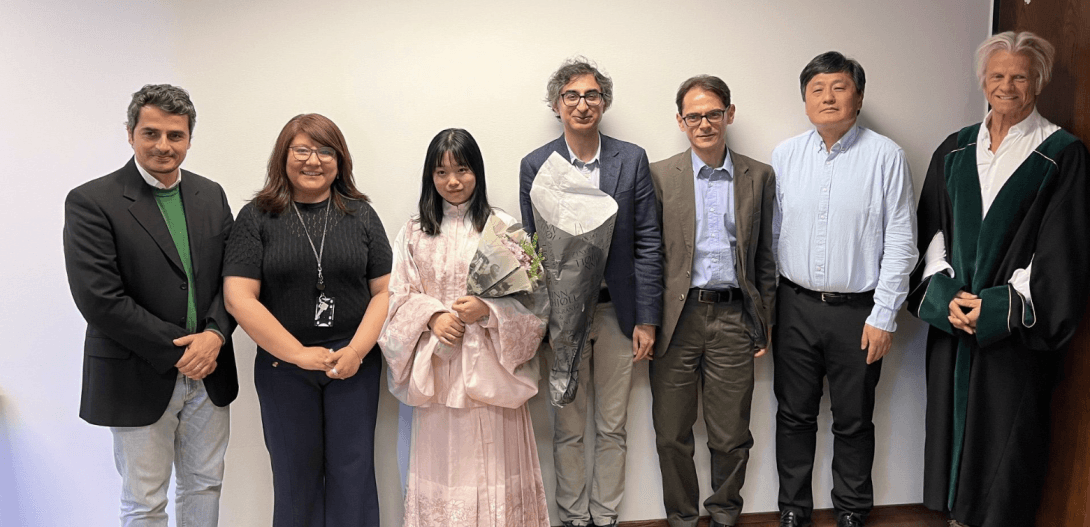
Xinyi Wang defended her thesis
Published:
On Thursday, April 30 at 13:15, Xinyi Wang defended her PhD thesis "When Quantum Computing Meets Software Testing: Novel Quantum Methods for Testing Real-World Software Systems".
The defence took place at Kristen Nygaards sal (5370), Ole Johan Dahls hus (UIO).
Main research findings
Modern software systems are growing in scale and complexity by including elements such as cyber-physical components and autonomous functionalities. These developments create significant challenges for traditional software engineering methods, requiring new computational paradigms. Meanwhile, quantum computing is attracting increasing attention for its potential to provide substantial computational advantages by leveraging principles of quantum mechanics. While quantum computing has shown promising results in fields such as chemistry, finance, and healthcare, its application in software engineering remains limited.
Inspired by the success of quantum computing in these domains, this thesis proposes hybrid quantum-classical approaches for addressing industrial and real-world software engineering challenges, with a particular focus on software testing. The thesis applies quantum optimization and quantum machine learning techniques to problems including test case optimization and test oracle generation. Experimental results show that the proposed approaches effectively solve targeted problems while improving computational efficiency. These findings demonstrate the feasibility and potential benefits of quantum computing. Additionally, the thesis outlines a broader research vision on applying quantum techniques across all phases of the software development life cycle.
Overall, this thesis provides both theoretical foundations and practical insights, and paves the way for future research on quantum algorithms for software engineering.
Quantum computing is rapidly developing and has shown potential to solve complex computational problems across various domains. To this end, this thesis explores its application to software engineering through hybrid quantum-classical approaches, with a particular focus on software testing challenges. Experimental results demonstrate the effectiveness and efficiency of the proposed approaches, highlighting the feasibility and potential of quantum computing in software engineering.
Prior to the defence, at 11:15, Xinyi presented her trial lecture "Fundamentals of quantum computing and practical applications" in the same location.
Adjudication committee
- Professor Elisabetta Di Nitto, DEIB - Politecnico di Milano, Milano, Italy
- Associate Professor João Paulo Fernandes, New York University Abu Dhabi, United Arab Emirates
- Associate Professor Silvia Lizeth Tapia Tarifa, Department of Informatics, University of Oslo, Norway
Supervisors
- Professor Xing Cai, Simula Research Laboratory and University of Oslo, Norway
- Professor Shaukat Ali, Simula Research Laboratory and Oslo Metropolitan University, Norway
- Associate Professor Paolo Arcaini, National Institute of Informatics, Japan
Chair of defence
- Professor Tor Skeie, Department of Informatics, University of Oslo, Norway
Read more at the UiO Department of Informatics web page.