FEniCS team members win the 2026 Lanczos Prize for Mathematical Software
Published:
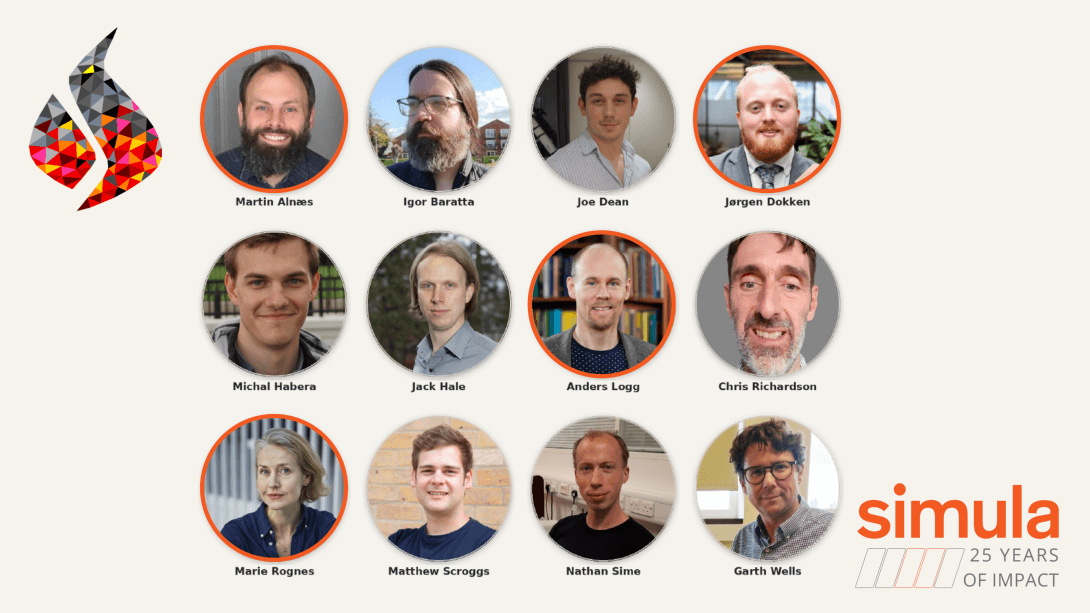
Today, members of the FEniCS core team have been awarded the 2026 ECMI/EMS Lanczos Prize for Mathematical Software!
Awarded jointly by the European Consortium for Mathematics in Industry (ECMI) and the European Mathematical Society (EMS), the prize recognises exceptional research in the development of mathematical software. The committee commended the FEniCS Project specifically "for revolutionising the implementation of the finite element method". The prize was awarded at the 23rd ECMI Conference on Industrial and Applied Mathematics in Kaunas, on the 2nd of July, 2026 (EMS press release).
Notably, four current and former Simula researchers, Martin S. Alnæs, Jørgen S. Dokken, Anders Logg, and Marie E. Rognes, are among the named recipients of the prize, highlighting Simula’s fundamental, decades-long involvement in the development and stewardship of the FEniCS Project; an involvement that has been instrumental in promoting the success of the project.
Overcoming the manual coding bottleneck
At its core, FEniCS is a computing platform designed to automate the finite element method, removing barriers between these methods’ mathematical formulation and efficient execution. Before its widespread adoption, translating complex partial differential equations (PDEs) into computational code was a long, manual process.
"Before this, there have been many ways of trying to describe these kinds of problems you want to solve in an easy way," explains Jørgen S. Dokken, a Senior Research Engineer at Simula. "But then you often had to write out the code to do these hard things by hand."
The FEniCS approach entirely changed this by taking a domain-specific mathematical language, the Unified Form Language (UFL), pioneered by Anders Logg, Martin S. Alnæs, and coauthors, and automatically compiling the underlying code.
"The FEniCS code generation pipeline takes a compact mathematical expression and generates tens of thousands of lines of code," says Dokken. "You went from this abstract, almost mathematical syntax to having generated code automatically, without having to write it. Almost like a translator, to put it in simpler terms."
In the words of the laureates
We sat down with Simula Chief Research Scientist Marie E. Rognes and Senior Research Engineer Jørgen S. Dokken to discuss what this international recognition means for the team and the broader scientific community.
Marie, what does it mean to you and the team to receive the Lanczos Prize?
Marie E. Rognes: "We are of course incredibly excited to receive the Lanczos Prize and super proud on behalf of the FEniCS core team and the FEniCS software. It has been a huge effort over very many years. So, it is really nice to receive this kind of official recognition of the project and the core team."
Why do you believe the committee chose FEniCS for this award?
Marie E. Rognes: "FEniCS has had a tremendous impact on mathematical software research over the last twenty years. It has enabled science globally, in terms of enabling people to use computational modeling and simulation to solve problems in biology, in physics, in chemistry, in the material sciences, even in the social sciences. And also, there is this aspect that other finite element projects and other mathematical software researchers have picked up on ideas that emerged early on through FEniCS, used them and taken them further."
Jørgen S. Dokken: "I think the committee chose FEniCS, one, because of its educational aspect, in the sense that it has been widely adopted in teaching. It has made it very easy to go from quite complex mathematics to quite simple ways of just showing: 'this is what you do, this is the maths you have, then you have a solution.' But then you also have the fact that it has changed how other finite element practitioners, other researchers, develop their code."
The nomination text notes that FEniCS removes barriers to "efficient execution." How does it handle industrial-scale problems?
Marie E. Rognes: "A key part of this is both the simplicity, making it easier for people, taking down the time for development for the users, but also the focus on efficiency and high performance at the same time. So, it is not a toy software for solving toy problems. It is a software for solving real problems, large-scale problems that really call for high-performance computing. But you can use the same code to do both, to scale from a small laptop to an exascale cluster."
Can you share some concrete examples where FEniCS has been deployed in practice?
Jørgen S. Dokken: "Rolls-Royce. They have been working with Garth Wells’ group at the University of Cambridge since around 2018, on creating their own software extension on top of FEniCS to perform simulations as an alternative to using proprietary software. The goal of the collaboration is to perform the first high-fidelity simulation of a full jet engine."
Marie E. Rognes: “At Simula, FEniCS has been at the core of our research in scientific computing in general and biomedical computing in particular since 2007. Having FEniCS as a shared computational infrastructure has enabled us to simulate a wide range of physiological processes – including blood flow in aneurysms as an indicator for rupture risk, cerebrospinal fluid flows to predict drug delivery around and into the human brain, and electrical conduction and mechanical loads on a beating human heart to mention but a few examples.”
The Simula legacy
While the FEniCS Project originally grew out of an international collaboration, it found a crucial developmental home at Simula Research Laboratory around 2005.
Through the Center of Excellence for Biomedical Computing, led by the late Hans Petter Langtangen, Simula provided the long-term funding, stability, and dedicated research engineering support needed to scale the project. As Marie E. Rognes notes, "Simula was not where it emerged, but it really was the place where it took flight and where it could grow."
Learn more about FEniCS
For a detailed timeline and history of how this software evolved, read our dedicated feature article: A Brief History of FEniCS and the Evolution of Automated Scientific Computing.
Visit The FEniCS Project official website on the software, documentation, and the global developer community.
A Simula 25 years - FEniCS workshop will be held at Simula the 8th and 9th of September and registration is open now. Full information on the event page.